


Silicon Valley has a problem it cannot ship its way out of. The American public, the same public that adopted AI faster than any technology in history, has turned skeptical of the people building it. In Pew Research Center polling published in August 2026, 52 percent of Americans say they are more concerned than excited about AI in daily life, up from 37 percent in 2021. For the first time, many adults under thirty, the heaviest users of all, share that concern. Sixty-three percent say AI is advancing too fast, and only 16 percent expect its twenty-year impact on society to be net positive. A CNBC Generation Lab poll of young Americans found that a majority distrusted every one of the nine most prominent AI leaders they were asked about. Every single one.
The distrust is no longer an attitude. It has become policy. Local resistance blocked or delayed at least 75 data center projects worth roughly $130 billion in the first quarter of 2026 alone. Thirteen Maryland counties, more than half the state, have adopted data center moratoriums. Texas halted up to 1,800 projects under Governor Abbott’s August directive. New York and Pennsylvania have imposed their own stoppages and restrictions, and a federal moratorium bill now sits in the Senate. An Annenberg poll found more than 60 percent of Americans oppose an AI facility being built in their own area, and an Echelon survey found that a data center polls worse in a community than a nuclear power plant. The industry building the future is now less welcome next door than fission.
Watch the 6-minute film. The essay, film, and sources are also at lifestylecareailab.com.
Much of the backlash is not really about Silicon Valley at all. Chronic illness had become the baseline condition of American life long before the first large language model shipped. Wages, utility bills, and household stress have been rising for reasons far bigger than any one industry. And the engagement-optimized systems that trained the public to feel extracted from were built across a whole economy of media, advertising, and attention, not by any single company or valley. But fairness is not the currency of public opinion; perception is. The perception, right now, is that technology takes from people their attention, their data, their jobs, their electricity rates, their water, and, most corrosively, their sense of being in charge of their own lives. Roughly seven in ten workers, blue-collar and white-collar alike, believe AI will mean fewer job opportunities, according to a Quinnipiac University poll in March 2026. You cannot message your way past a perception that strong. You can only replace it with a different lived experience, and Silicon Valley is the one place on earth with the capability to build that experience on a national scale fast.
The perception is the opportunity
Here is the reframe this moment demands. The public’s underlying diagnosis contains a distinction that the moratorium movement misses, and it is the distinction on which the industry’s next decade rests. The danger was never intelligence, and it was never the people building it. The danger is direction. The same technology that can be aimed at a person to extract their attention can be aimed, with equal precision, at strengthening their health, their judgment, their sense of purpose, and their capacity to act for themselves. AI is a lens: it magnifies whatever it is pointed at. For most of the last decade, the systems shaping daily behavior, wherever they were built, were pointed at people. They can be pointed at prosperity for people. Human prosperity is the solution.
So, the solution to the backlash is not to abandon AI, and it is certainly not for Silicon Valley to accept a caricature of itself as the villain. The solution is to redeploy AI, visibly, measurably, and in every zip code, against the very harm the public is protesting, and to let the Valley’s unmatched capacity for building at scale become the proof. That is the thesis of Building a Human Future, and it is why the Lifestyle Care Sector is the counternarrative Silicon Valley has been unable to write for itself.
What the public would feel
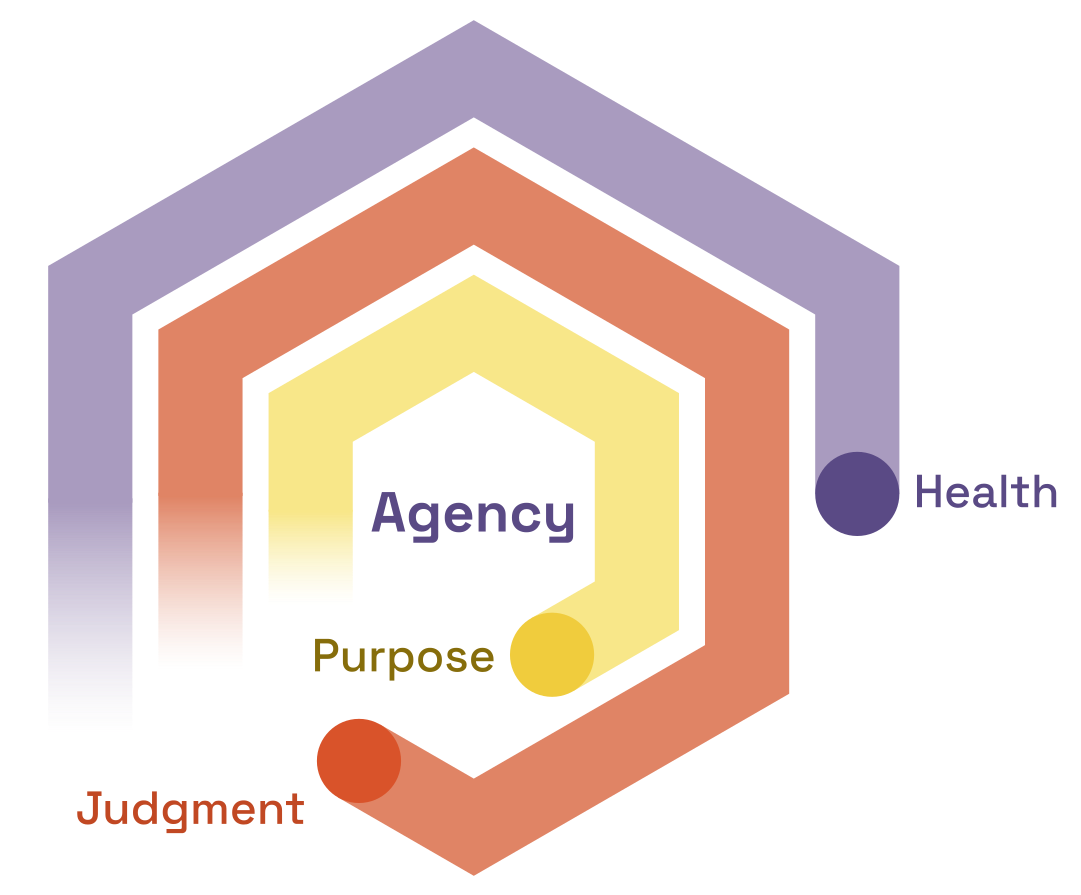
The Lifestyle Care Sector is the missing upstream half of American healthcare. The clinical system we have is built to restore health after deterioration; it is indispensable, and it is downstream by design. Meanwhile, 90 percent of the nation’s $5.3 trillion in annual health spending (2024) is tied to people with chronic and mental health conditions, much of it driven by modifiable daily behavior: sleep, movement, nutrition, stress, loneliness, attention. Lifestyle Care is the sector that owns that upstream life. Healthy Behavioral Algorithm packages pursue goals the person defines, deployed at the community level through a credentialed human workforce, and measured on human outcomes of health, judgment, purpose, and agency.
Consider what that architecture does to each pillar of the current backlash.
It answers the jobs fear with the rare AI story that creates jobs. The public’s deepest anxiety is that AI advancement means fewer opportunities. The Lifestyle Care Professional (LCP) workforce inverts that. If AI is going to scale influence over human behavior, people need more skilled human guidance, not less. Recruiting, training, credentialing, supporting, and paying this workforce is itself the platform: tens of thousands of Lifestyle Care Professionals by 2027 and hundreds of thousands by 2029, in every U.S. zip code, urban and rural, on a path to an estimated one million jobs. When a technology’s success is measured partly in the number of neighbors it puts to work, the employment narrative flips from threat to lifeline. No press release does that. A paycheck does.
It answers the agency fear with agency as the product. The quiet grievance beneath the polls is a sense of outsourced living, where more decisions are made for people, slightly to their detriment, by systems they never see. Healthy Behavioral Algorithms are architected against that failure mode: consent as the starting point, person-set goals, legible mechanics, a human in the loop, and a standard written into the measurement system itself. If a system claims to help you while quietly making you more dependent on it, it has failed. This is not a values statement. It is a scoreboard the public can audit.
It answers the data center revolt with a visible community dividend. Communities are not rejecting compute; they are rejecting compute they cannot see the benefit of. A moratorium is what a community does when it cannot feel what it is getting. The Lifestyle Care Sector makes the benefit local and legible. The infrastructure exists to power programs delivered in that community, by Lifestyle Care Professionals who live there, with outcomes reported to that community on sleep, metabolic health, crises, and claims. When the question changes from “what does this facility take from us?” to “what does this ecosystem give our families?”, the politics change with it. Governor Abbott’s own guardrails (don’t take the water, don’t strain the grid, lower costs) are a demand for exactly this kind of accountable presence. Silicon Valley should not fight that demand. It should exceed it.
It answers the trust deficit with proof, not promises. Confidence in AI’s leaders has fallen because claims have run ahead of outcomes, an industry-wide pattern rather than any one company’s sin. Lifestyle Care inverts the sequence with a baseline, plan, continuous support, quarterly outcome review, measured across six domains of health preservation, judgment, purpose, agency, safety, and economic signals like healthcare claims and utilization. Smaller claims, proven, beat larger claims, asserted. Trust is not a campaign. It is the residue of doing what you said you would do, in the open, long enough that people stop bracing for the catch.
The invitation
We are early, and we are going to talk like it. We are not here to tell you we have already fixed anything. We are telling you what we are building and how we intend to be judged.
The convergence driving public fear is real. Chronic illness has become the baseline condition of modern life, engagement-optimized algorithms exploit the vulnerability that stress creates, and AI-driven disruption is reshuffling work and identity at once. Left alone, those forces compound, and so will the backlash, because people push back against what they believe is draining them. But the same convergence defines the largest positive-impact category available to this industry. A trillion-dollar reallocation from downstream treatment to upstream flourishing, in the one domain, health, where every American can feel the difference in their own body, their own household, their own town.
The Lifestyle Care Professional workforce is where the Lifestyle Care Sector begins. It is the sector’s starting point and its first proof. Before the platforms and before the contracts, there are people in zip codes, credentialed professionals co-designing goals, building routines that survive a hard week, using AI to personalize rather than persuade, and protecting the agency of every participant. Building that workforce is the first, most visible act of Building a Human Future, and it is open now.
Becoming a Founding Professional
Interested in serving your community as a Lifestyle Care Professional? Subscribe as a Founding Professional to the Building a Human Future newsletter and reserve LCP positions in your zip code with first right of refusal as the workforce rolls out nationally.
For Silicon Valley researchers and investors, the invitation is to build the category with us as a partner on Healthy Behavioral Algorithm design, evaluation, and safety standards, and back the Lifestyle Care Sector’s ecosystem infrastructure as a distinct bet.
For Researchers and Investors
Join as a paid subscriber for the latest information on the development of the Lifestyle Care Sector for Building a Human Future with the standards, the outcomes, the deployments, and the openings to participate as the sector forms.
Silicon Valley does not need to win an argument with the public, and it does not need to accept the blame for forces larger than itself. It needs to be given public evidence like a neighbor employed as a Lifestyle Care Professional, a parent sleeping through the night again, an algorithm a participant can inspect and tune, a community that sees its outcomes improve quarter after quarter. That is what it looks like when AI strengthens people instead of quietly draining them of their agency, and it is the only story capable of turning moratoriums into partnerships. A human future is not guaranteed by good intentions or prevented by bad ones. It gets built, or it doesn’t, by the people who show up to build it. The future is coming whether we plan for it or not. We would rather build one worth shipping.
Reading this in your inbox? Just reply. It comes straight to me.
Sources
Public-opinion, policy, and spending figures are drawn from:
Pew Research Center (fielded June 2026, published August 2026)
Quinnipiac University Poll (March 2026)
CNBC Generation Lab
Annenberg Public Policy Center
Echelon Insights
Data Center Watch (Q1 2026)
State actions reported in Texas, New York, Pennsylvania, and Maryland (August 2026)
Centers for Disease Control and Prevention (CDC)
CMS National Health Expenditure Accounts (2024)
Workforce figures are Lifestyle Care targets.
Lifestyle Care AI Lab · Menlo Park, CA