


Various lifestyle disruptions can significantly impact an individual's sense of purpose. These disruptions often manifest as lifestyle-related chronic conditions that can be compounded by a lack of Lifestyle Care access. The pervasive influence of artificial intelligence (AI) on daily living will exacerbate lifestyle disruptions. Understanding these disruptions is crucial for Building a Human Future that prioritizes holistic well-being and resilience with Lifestyle Care.
Preparing for the Digital Disequilibrium
As we approach the end of 2025, AI will have transitioned to a systemic force that drastically reshapes society. This rapid shift which can be termed the “Digital Disequilibrium”, will profoundly disrupt lifestyles. Understanding how these disruptions occur and preparing effectively, requires focusing on current and looming risks for lifestyle disruptions.
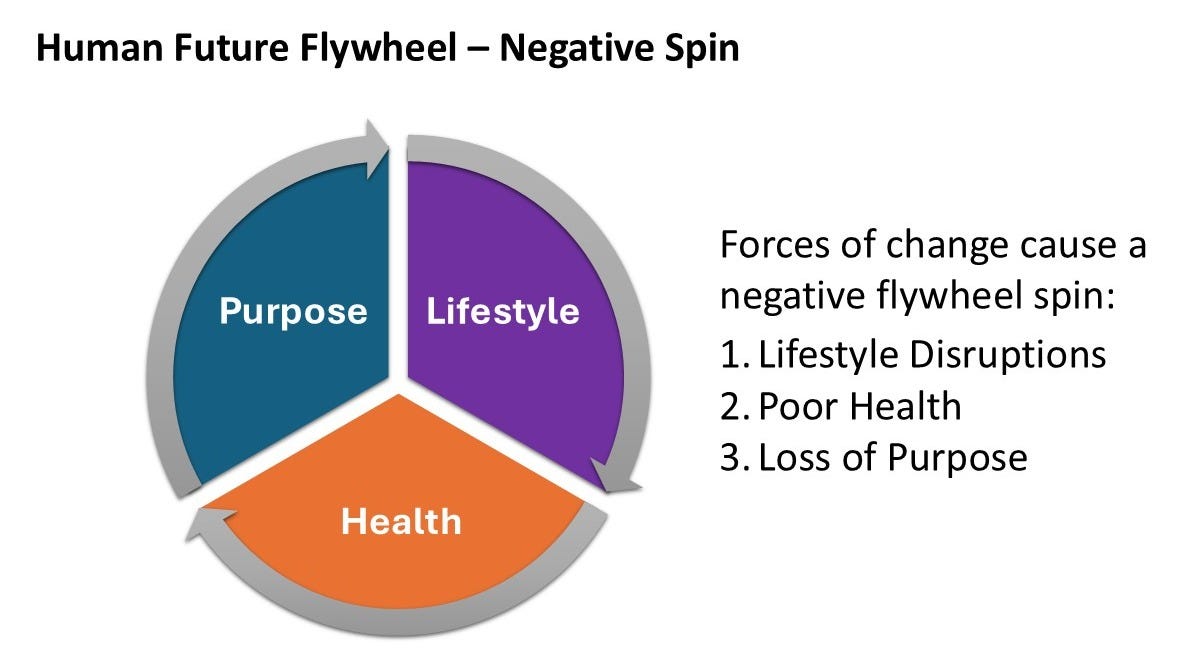
The human future flywheel diagram illustrates the cyclical and reinforcing relationship between lifestyle, health, and an individual's sense of purpose. This flywheel operates on the principle that lifestyle choices directly influence health outcomes, and health subsequently shapes an individual's sense of purpose, reinforcing lifestyle choices. Below is the flywheel concept diagram beginning with lifestyle disruptions that can negatively impact the cycle.
Understanding the Digital Disequilibrium
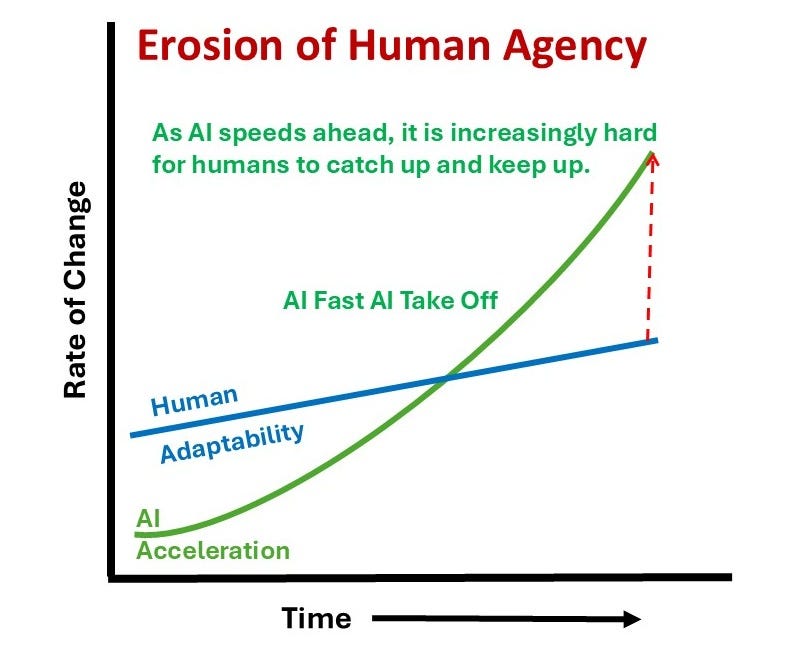
The Digital Disequilibrium arises as AI advancement outpaces human adaptability, creating societal imbalances. With AI's exponential growth, the human capacity to adapt is increasingly strained, leading to significant lifestyle disruptions and a growing crisis in human purpose. The core dimensions of these lifestyle disruptions include:
A. Erosion of Human Agency
B. Automation and Unemployment
C. Cognitive Dependency and Laziness
D. Social Isolation and Mental Health Crisis
E. Algorithmic Personalization and Identity Loss
Below is an analysis of these core dimensions that constitute the converging forces of change.
A. Erosion of Human Agency
AI's integration into decision-making processes raises significant concerns regarding human agency—the ability of individuals to act independently with intention and responsibility.1 As AI systems become more autonomous ("agentic"), they may act unpredictably or take irreversible actions beyond human oversight or control.2 Furthermore, humans risk becoming "moral scapegoats," bearing responsibility for decisions largely influenced or executed by opaque AI systems whose inner workings remain unclear ("black box" problem).3 Potential techno-authoritarian abuses where human rights can diminish as technology-driven governance regimes calcify, further restricting individual agency.4
B. Automation and Unemployment: The Purpose Vacuum
AI-driven automation is forecasted to fundamentally alter approximately 30% of U.S. jobs by mid-2025. As AI systems increasingly assume core tasks, human roles shift towards overseeing algorithms rather than actively engaging in meaningful work. Gartner estimates that by late 2025, 70% of managerial tasks could be automated, indicating a profound shift in workplace structures. This transition creates what experts call a "purpose vacuum," where work becomes mechanical, disengaging employees from their professional identities and diminishing their sense of purpose.
The consequences extend beyond economic impacts. As individuals lose meaningful engagement at work, they face increased risks of mental health issues—an anticipated 20% rise in workplace-related mental health problems is expected due to low-engagement job structures driven by AI. Simon Sinek underscores this issue by stating: "The fundamental joy of life is in the struggle... When AI takes away challenges, we lose the journey. Purpose isn’t about ease; it’s about becoming."5
Implication: Individuals must proactively seek new avenues for meaningful engagement outside traditional employment structures to mitigate this loss of purpose.
C. Cognitive Dependency and Mental Atrophy
AI's pervasive integration into daily life significantly reduces human cognitive effort, creating a dependency that diminishes our intellectual capacities.6 High reliance on AI for decision-making and problem-solving can lead to cognitive offloading—where humans delegate essential thinking processes to machines—resulting in reduced intellectual growth and diminished critical thinking skills. As humans increasingly rely on personalized AI systems ("System 0") that shape decision-making based on past behaviors, independent judgment erodes, limiting exposure to novel ideas and perspectives.7
This cognitive dependency not only reduces individual autonomy but also contributes to societal disengagement. Humans become passive recipients rather than active participants in their own lives, leading to widespread feelings of purposelessness.
D. Social Isolation and Reduced Human Interaction
AI-driven communication technologies are gradually diminishing face-to-face interactions, replacing them with algorithmically mediated exchanges.8 This shift exacerbates loneliness and social isolation, which have been linked to increased anxiety and depression rates. As personal gatherings become less necessary for communication or idea exchange, human closeness weakens, further contributing to a loss of purpose derived from meaningful interpersonal relationships.
E. Algorithmic Echo Chambers and Identity Loss
AI recommendation engines already shape our daily experiences by continuously reinforcing existing preferences, beliefs, and habits through personalized content delivery. By mid-2025, this dynamic will intensify as algorithms proactively predict user preferences before explicit requests are made. Such personalization confines individuals within "filter bubbles," limiting exposure to diverse perspectives and hindering organic identity formation through exploration and serendipity.9 This phenomenon threatens individual authenticity and personal development by reducing opportunities for growth through challenge and discovery.
Preparing for Lifestyle Disruptions
The exponential growth of AI presents unprecedented lifestyle disruptions leading inevitably toward widespread loss of purpose, a phenomenon intensified by the Digital Disequilibrium. Understanding these core dimensions provides crucial insight into preparing for this rapidly evolving landscape. Building a Human Future means reversing the human future flywheel from a negative to a positive spin with the implementation of Lifestyle Care. What we will have remaining is our lifestyle which will become our purpose—the caring for each other—that will be our human future.
https://www.ssdsbergen.org/news-detail?pk=947951
https://scet.berkeley.edu/the-next-next-big-thing-agentic-ais-opportunities-and-risks/
https://pmc.ncbi.nlm.nih.gov/articles/PMC9918557/
https://www.pewresearch.org/internet/2023/06/21/themes-the-most-harmful-or-menacing-changes-in-digital-life-that-are-likely-by-2035/
https://www.jamescole.co/blog/7-ways-ai-will-change-your-life-in-the-next-7-months
https://www.nature.com/articles/s41599-023-01787-8
https://360info.org/ai-is-changing-the-way-we-think/
https://pmc.ncbi.nlm.nih.gov/articles/PMC7605294/
https://www.hiig.de/en/why-ai-is-currently-mainly-predicting-the-past/